
How much does a serverless GPU cost compared with a VM?
Serverless H100s list at $2.60 to $5.89/hr, but cold starts and idle windows are billed too. A per-request cost model, three traffic profiles and a VM threshold.
Serverless H100s list at $2.60 to $5.89 an hour, but cold starts and idle windows are billed too, so 200 four-second requests a day still bill 3.4 to 5.6 GPU-hours. In our model that costs $14.46 a day on Nodus Functions, where the H100 SXM is listed at $2.60/hr, and $19.78 to $21.97 on Runpod and Modal, against $105.36 for an always-on Runpod H100 Pod. The VM wins much sooner than the hourly rates suggest: with Runpod’s own prices, at about 14% busy utilization rather than 74.5%.
We built this as a billing model, not a benchmark. The prices and billing rules come from each provider’s own pages, linked below. The traffic, request length and cold-start length are our assumptions, stated as such, and the method is described in full so you can rerun the math with your own numbers.
What does a serverless GPU bill you for besides the request?
Section titled “What does a serverless GPU bill you for besides the request?”You pay for every second a worker exists, and a worker exists for longer than your requests run. Three phases are billed on all three platforms we modeled: the cold start until your code is ready, the work itself, and an idle window after the last request in case another arrives.
The defaults differ, and that difference drives most of the bill:
- Nodus Functions keep an idle worker for
scaledown_window, one minute by default and up to 20 minutes, andmin_workers(default 0) sets how many stay warm with no traffic (scaling guide). An idle warm worker is billed at the Function’s worker rate, the same as a busy one (Functions guide). - Modal bills application load time and processing time per second, and keeps containers alive for 60 seconds after the last input by default, which it also bills (Modal pricing). The window can be set from 2 seconds to 20 minutes, and
min_containerskeeps a floor of warm containers (Modal cold start guide). - Runpod Serverless bills from worker start to full stop, rounded up to the second. Its idle timeout defaults to 5 seconds, and image pulls and cached model downloads that happen while a worker is scaled down are not billed (Runpod serverless pricing). Always-on active workers carry discounts through a sales inquiry, so we did not model them.
The H100 list rates we used: Nodus H100 SXM listed at $2.60/hr on the Nodus pricing page, Modal H100 at $0.001097 per second, about $3.95/hr, and Runpod Serverless H100 PRO flex at $5.89/hr. For the VM, we used a Runpod H100 SXM Pod on Secure Cloud at $4.39/hr, billed per second (Runpod pricing). Prices checked November 28, 2026.
If you want the basics of how serverless GPUs work, start with what a serverless GPU is. This post is only about the bill.
How did we model the bill?
Section titled “How did we model the bill?”We simulated one worker, request by request, under random (Poisson) arrivals for 30 days per traffic profile. A request that finds the worker gone triggers a billed cold start. A finished request keeps the worker alive for the provider’s default idle window, and a request inside that window starts warm. The script is a small Python standard-library file, serverless-gpu-pricing-model.py, and its results are what every number below comes from.
These are our assumptions, not provider facts:
- Each request uses 4 seconds of H100 time.
- A cold start bills 60 seconds on every platform, mostly loading weights into GPU memory.
- One worker at most, running one request at a time, with GPU charges only. CPU, memory, storage and egress are left out.
- Billing is continuous per second at list price.
The three traffic profiles are sparse (200 requests a day spread over 24 hours), business hours (one request a minute for 9 hours, about 540 a day) and steady (one request every 12 seconds, around the clock, about 7,200 a day).
What does a request really cost under each traffic pattern?
Section titled “What does a request really cost under each traffic pattern?”Sparse traffic is where the hourly rate misleads you most. At 200 requests a day, the H100 does 0.23 hours of real work, but Nodus and Modal bill 5.56 hours and Runpod Serverless bills 3.36. That is 24.7 and 14.9 billed hours per busy hour.
Runpod bills fewer hours because its 5-second idle window rarely holds a worker, but that also means 98% of requests waited on a cold start, against 87% with a 60-second window.
| Traffic profile | Busy GPU h/day | Nodus | Modal | Runpod Serverless | Runpod Pod, always on |
|---|---|---|---|---|---|
| Sparse, 200/day | 0.23 | $14.46 ($71.46) | $21.97 ($108.55) | $19.78 ($97.73) | $105.36 |
| Business hours, ~540/day | 0.60 | $17.51 ($32.25) | $26.60 ($48.98) | $29.35 ($54.06) | $105.36 |
| Steady, ~7,200/day | 8.01 | $62.12 ($8.62) | $94.36 ($13.09) | $126.84 ($17.60) | $105.36 |
Cost per day, with cost per 1,000 requests in brackets, from our model at the list prices above, checked November 28, 2026.
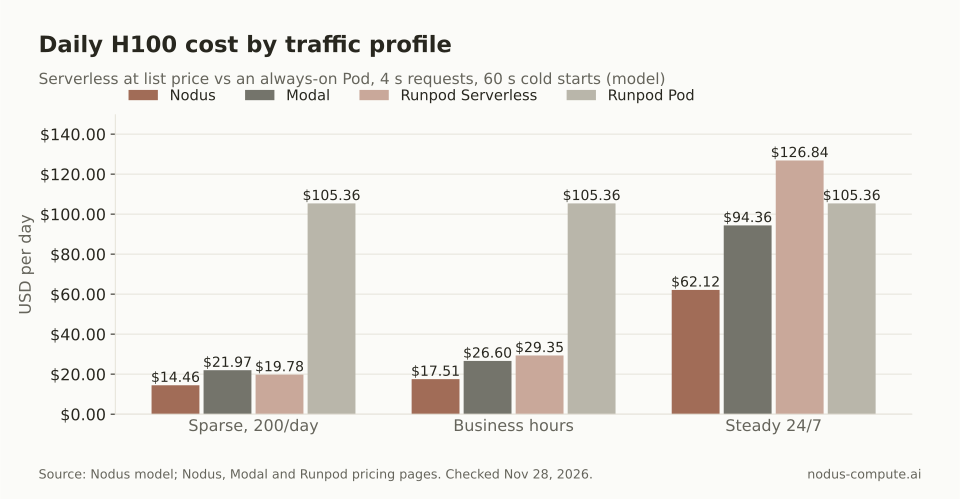 Serverless beats the always-on Pod for sparse and business-hours traffic on every platform, and loses on Runpod’s own prices at steady load.
Stopping the Pod outside business hours does not close the gap. Nine hours at $4.39 is $39.51 a day, still above every serverless figure for that profile.
At steady load the per-request cost falls to $8.62 to $17.60 per 1,000, because the worker rarely goes cold. Runpod is the exception on latency: with a 5-second window, 61% of steady requests still waited on a cold start, against 2.6% with a 60-second window.
At what utilization does an always-on VM become cheaper?
Section titled “At what utilization does an always-on VM become cheaper?”The VM wins when billed hours, not busy hours, cross the price ratio. With Runpod’s prices that ratio is $4.39 / $5.89 = 74.5% of the day. The trap is that billed time reaches 74.5% long before busy time does.
We swept 24/7 traffic from 200 to 18,000 requests a day in a separate 10-day simulation, so the 200-a-day row differs by a few cents from the table above.
| Requests/day | Busy | Nodus | Modal | Runpod Serverless | Runpod Pod |
|---|---|---|---|---|---|
| 200 | 0.9% | $14.50 | $22.02 | $19.79 | $105.36 |
| 1,000 | 4.6% | $40.15 | $60.98 | $64.06 | $105.36 |
| 2,000 | 9.3% | $51.72 | $78.57 | $90.30 | $105.36 |
| 3,000 | 13.9% | $57.15 | $86.81 | $104.33 | $105.36 |
| 5,000 | 23.1% | $61.03 | $92.70 | $118.69 | $105.36 |
| 10,000 | 46.3% | $62.37 | $94.73 | $132.64 | $105.36 |
| 18,000 | 83.3% | $62.40 | $94.79 | $139.87 | $105.36 |
Daily H100 cost from our model at list prices checked November 28, 2026.
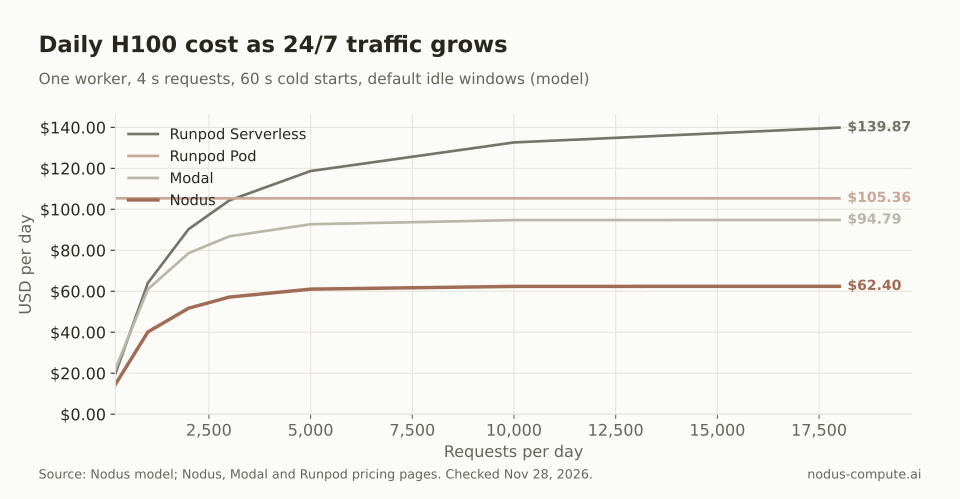 Serverless cost climbs fast at low traffic, then flattens once the worker never goes cold.
On Runpod’s own prices, Serverless passes the Pod at about 3,120 requests a day, or 14.4% busy utilization, roughly 3.5 busy hours a day. The cold-start length moves that threshold more than anything else. With the 5-second default window, it sits at 36.5% busy with a 10-second cold start, 22.8% at 30 seconds and 14.4% at 60 seconds.
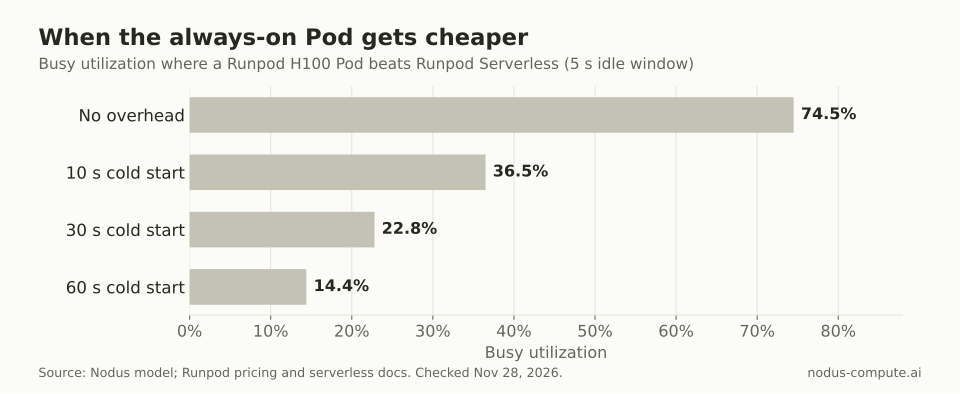 Every second of model load pulls the VM break-even lower.
The decision rule we take from this: estimate billed hours as busy hours plus one cold start per gap longer than the idle window, plus the idle window after each burst. If that total, times the serverless rate, exceeds 24 hours at the VM rate, keep the VM. If you cannot estimate the gaps, treat 15% busy utilization as the warning line for 60-second cold starts and around 35% for 10-second ones.
Why can’t Nodus Functions cost more than one warm worker?
Section titled “Why can’t Nodus Functions cost more than one warm worker?”On Nodus, scale to zero has no price premium, so the most one worker can bill in a day is the same as keeping it warm. An idle warm worker is billed at the Function’s worker rate, so 24 hours of a worker priced at the H100 SXM rate is $2.60 x 24 = $62.40. In the sweep, Nodus cost rises toward that line and stops there.
Modal works the same way at its rate: 86,400 seconds x $0.001097 = $94.78 a day with min_containers=1. With equal rates for busy and warm time, choosing min_workers=1 is a latency decision. You trade the sparse profile’s $14.46 for $62.40 a day, and no request waits on a cold start.
Before you deploy, Nodus prints the expected cost, the cold and warm start bands and the worker’s hourly rate, as the scaling guide shows:
print(embed.estimate("hello")) # expected cost, cold and warm start times, and the hold$ nodus get function embed -o jsonpath={.status.estimate}Check status.estimate.rateUSDPerHour there for the exact worker rate rather than assuming the list price.
Where are Runpod or Modal the better choice?
Section titled “Where are Runpod or Modal the better choice?”Runpod’s 5-second default window bills the least idle time on sparse traffic: 3.36 hours a day against 5.56 in our model. If your model loads fast, for example with FlashBoot or model caching, which Runpod’s docs recommend for cutting cold starts, that short window becomes an advantage. Runpod also lists H100 SXM Pods from $2.69/hr on Community Cloud, a cheaper always-on option than the Secure Cloud price we modeled (Runpod pricing).
Modal’s Starter plan includes $30 of compute a month, which covers a lot of sparse traffic at the costs above (Modal pricing). Its buffer_containers setting adds warm capacity only while a Function is active, which suits bursty sessions (Modal cold start guide). For a broader ranking, see the best serverless GPU platforms in 2026.
How much does serverless GPU cost?
Section titled “How much does serverless GPU cost?”Serverless H100s list at $2.60 to $5.89 an hour on the platforms above, billed per second. The real cost depends on billed overhead: in our model, sparse traffic paid $71.46 to $108.55 per 1,000 four-second requests and steady traffic $8.62 to $17.60.
Should I set a longer idle window to avoid cold starts?
Section titled “Should I set a longer idle window to avoid cold starts?”Only if requests usually arrive within the window. Each window that expires unused is pure cost, so match it to your typical gap between requests, not your worst one.
Do these figures include CPU, memory and storage?
Section titled “Do these figures include CPU, memory and storage?”No, the model counts GPU time only. Modal meters CPU and memory separately (Modal pricing), and Runpod Serverless adds container disk at about $0.10/GB a month and network volumes at $0.07/GB a month under 1 TB (Runpod serverless pricing).
What limits how much a Nodus Function can spend?
Section titled “What limits how much a Nodus Function can spend?”Your credit balance. A Function does not take a spend cap yet, so max_cost is refused at deploy, and min_workers keeps workers running until you stop the Function (Function spending controls). When the balance runs out, workers drain and new calls queue until you add credit.
More from the blog
training9 min read
Which open-source model is best to fine-tune in 2026?
Qwen3.5 and Gemma 4 are the best open models to fine-tune for most tasks in 2026. A task-by-size table, licenses, a decision rule and worked VRAM math.
Read the postimage-generation6 min read
How do you evaluate a text-to-image model beyond image quality?
A beautiful image can still fail the brief. Count usable results per request, check object relationships and compare models under the same selection budget.
Read the post